



|
|
ISSN 3105-7454(Print)
|
| 杂志简介 | 更多... |
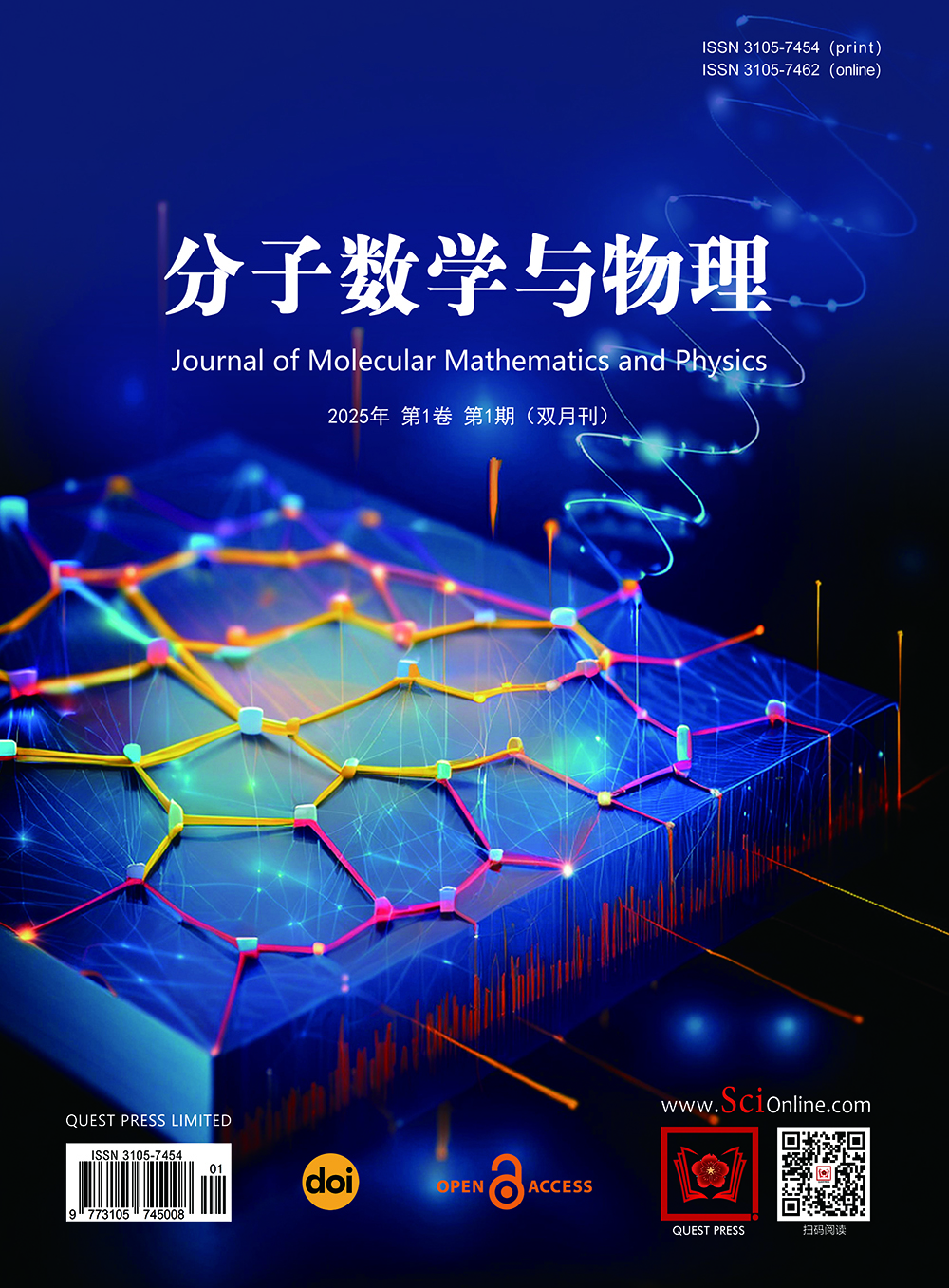
中文刊名:《分子数学与物理》
英文刊名:Journal of Molecular Mathematics and Physics
国际刊号:ISSN 3105-7454(印刷版) / ISSN 3105-7462(网络版)
出版模式:金色开放获取(Gold OA),适用CC BY 4.0协议(全文永久免费)
出版机构:QUEST PRESS LIMITED
出版频率:双月刊
投稿语言:中文(需附英文标题、摘要、关键词、作者单位及姓名)
核心定位
《分子数学与物理》是一本聚焦分子尺度下数学理论与物理现象交叉研究的国际化学术期刊。本刊致力于推动数学方法与物理原理在分子科学研究中的深度融合,重点关注分子系统的数学建模、理论分析与计算模拟。我们特别鼓励采用 rigorous mathematical derivation(严格数学推导)、advanced physical theories(先进物理理论)与 computational verification(计算验证)相结合的跨学科研究方法,为分子科学与基础学科的发展提供理论支撑。
约稿范围
本刊欢迎以下研究方向的投稿:
分子动力学数学理论与算法
量子化学计算方法与数学基础
分子系统统计力学与随机过程
分子尺度多物理场耦合建模
分子结构数学表征与拓扑分析
表面与界面现象的数学物理描述
分子自组装理论与动力学
软物质系统数学物理模型
分子光谱学理论计算方法
生物大分子理论与计算生物物理
目标与愿景
本刊旨在成为分子数学与物理交叉领域的权威学术平台,推动理论方法创新与学科融合发展。我们致力于构建完整的分子系统理论框架,为数学家、物理学家、化学家及跨学科研究者提供高水平的学术交流空间,促进基础科学理论的突破性进展。
全球数据索引计划
本刊正在申请纳入以下重要学术数据库:
Science Citation Index Expanded (SCIE)
Ei Compendex
Scopus
INSPEC
zbMATH Open
DOAJ (Directory of Open Access Journals)
Google Scholar
百度学术 (Baidu Scholar)
万方数据 (Wanfang Data)
维普资讯 (VIP)
澳门虚拟图书馆 (Macau Virtual Library)
龙源期刊网 (Longyuan Journal Network)
超星学术平台 (Chaoxing)
长江文库 (Yangtze River Database)
新华网学术中国 (Xinhuanet Academic China)
CNKI 中国知网
Journal of Molecular Mathematics and Physics Call for Papers
Journal Information
Journal Title (English): Journal of Molecular Mathematics and Physics
Journal Title (Chinese): 《分子数学与物理》
ISSN: 3105-7454 (print) / 3105-7462 (online)
Publishing Model: Gold Open Access (under CC BY 4.0 license)
Publisher: QUEST PRESS LIMITED
Publication Frequency: Bimonthly
Language of Submission: Chinese (must include English title, abstract, keywords, and author affiliations/names)
Core Focus
The Journal of Molecular Mathematics and Physics is an international academic journal focusing on interdisciplinary research at the intersection of mathematical theories and physical phenomena at the molecular scale. The journal is dedicated to advancing the deep integration of mathematical methods and physical principles in molecular science, with particular emphasis on mathematical modeling, theoretical analysis, and computational simulation of molecular systems. We particularly encourage interdisciplinary research approaches that combine rigorous mathematical derivation, advanced physical theories, and computational verification to provide theoretical support for the development of molecular science and fundamental disciplines.
Scope
We welcome submissions in the following areas:
Mathematical Theory and Algorithms of Molecular Dynamics
Quantum Chemical Methods and Mathematical Foundations
Statistical Mechanics and Stochastic Processes in Molecular Systems
Multi-physics Modeling at the Molecular Scale
Mathematical Characterization and Topological Analysis of Molecular Structures
Mathematical Physics Description of Surface and Interface Phenomena
Theory and Kinetics of Molecular Self-assembly
Mathematical Physics Models of Soft Matter Systems
Theoretical Methods in Molecular Spectroscopy
Theory of Biomacromolecules and Computational Biophysics
Aims and Vision
Our goal is to establish the Journal of Molecular Mathematics and Physics as an authoritative academic platform in the interdisciplinary field of molecular mathematics and physics, promoting theoretical innovation and disciplinary integration. We are committed to building a comprehensive theoretical framework for molecular systems, providing mathematicians, physicists, chemists, and interdisciplinary researchers with a high-level academic exchange space to facilitate breakthrough progress in fundamental scientific theories.
Global Indexing Plan
The journal is pursuing inclusion in the following major academic databases:
Science Citation Index Expanded (SCIE)
Ei Compendex
Scopus
INSPEC
zbMATH Open
DOAJ (Directory of Open Access Journals)
Google Scholar
Baidu Scholar
Wanfang Data
VIP Information
Macau Virtual Library
Longyuan Journal Network
Chaoxing Academic Platform
Yangtze River Database
Xinhuanet Academic China
CNKI (China National Knowledge Infrastructure)
| 往期阅览 | 更多... |



|
三种测量三棱镜折射率方法的讨论
|
 |
|||||
|
||||||
| 张秀莉 | ||||||
| 摘要:折射率不仅与几何光学有关,与波动光学也有密切联系,对其的测量方法也多种多样。为了研究不同方法对测量折射率精度的影响,本文利用分光计实验仪器研究了三种不同实验方法测量了三棱镜的折射率,包括掠射法、最小偏向角法和布儒斯特角法,并对三种实验方法测量计算出来的折射率,进行了分析比较。实验结果表明,相对于布儒斯特角法测量三棱镜的折射率,掠射法和最小偏向角法测量的结果更为准确。本文为精确测量三棱镜折射率提供了可参考性的实验方法。 | ||||||
|
STEAM教育理念下电场自动测绘仪的开发
|
|
|||||
|
||||||
| 石华伟 | ||||||
| 摘要:将静电场教学实践中遇到的问题,作为课外拓展课题研究是新工科人才培养的有效方式之一。本文基于STEAM教育理念,采用项目式学习,以学生为主体,以跨学科融合和创新为导向,制定教学目标和教学方法。将物理理论和实验创新有机融合,引导学生结合单片机技术和Matlab程序,设计出新型可视化电场自动测绘仪。该仪器操作简便高效,测量精度高,还能直观展示电场的动态变化。而学以致用的过程,提高了学生的创新能力和知识综合运用能力,也为高校的教学改革提供了新思路。 | ||||||
|
新工科背景下量子力学教学内容优化研究
|
|
|||||
|
||||||
| 郭媛媛 | ||||||
| 摘要:量子力学是描述微观粒子运动规律的理论,在工科专业教学体系中起着基础性、先导性的作用。然而,当前工科专业的量子力学课程存在学时数少、学生数学知识储备不足的问题,给教学带来了巨大的挑战。为了解决上述问题,本文在新工科建设的背景下,对量子力学教学内容的优化开展了深入的探索研究。在多年教学实践基础上,根据立德树人的教育根本任务、量子力学课程特点以及我校微电子科学与工程专业教学情况,对量子力学教学内容给出了具体优化措施,并取得了较好的教学效果。 | ||||||
|
| ||
|
| ||
|
| ||
|
| ||
|
| ||
|
| ||
|
| ||
|
| ||
|
| ||
|
| ||